
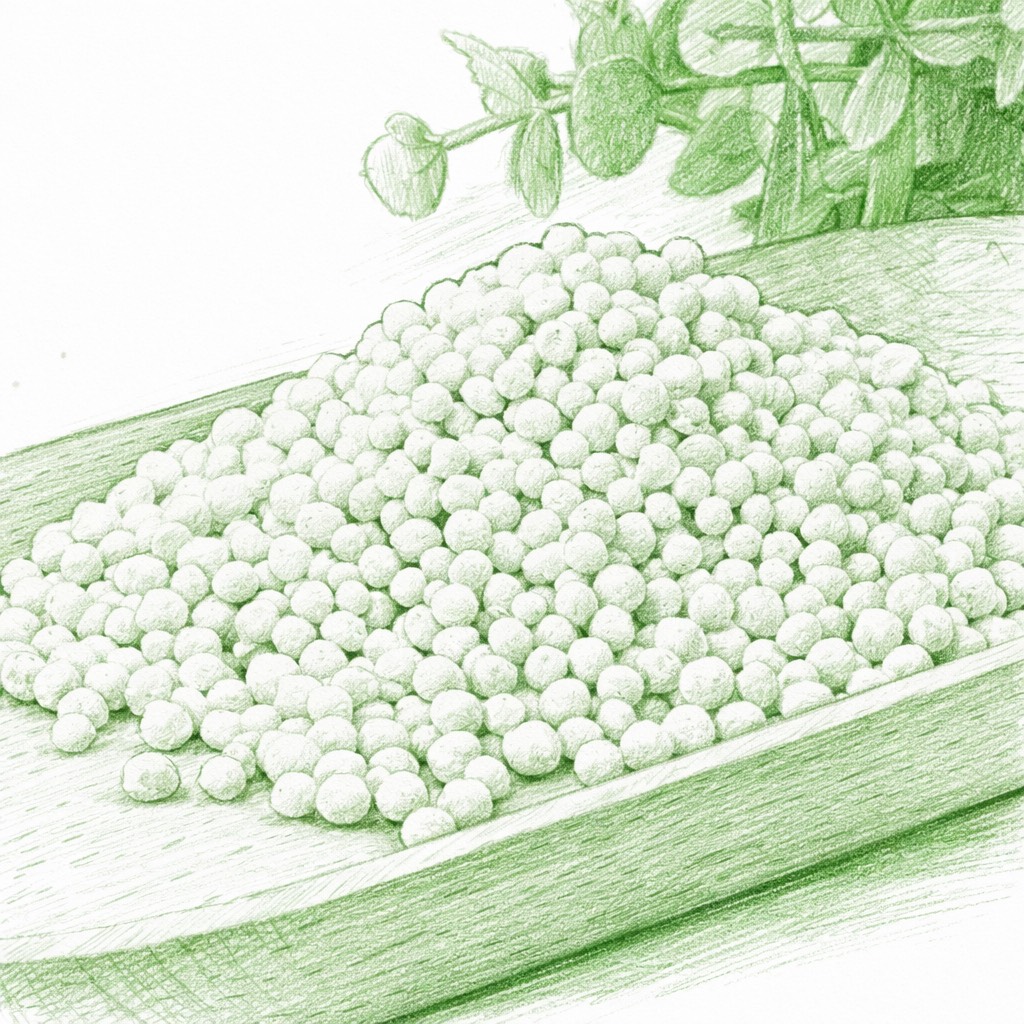
High-phosphorus, high-potassium positioning for targeted field nutrition
NPK 8:20:30 is a high-phosphorus, high-potassium granular compound fertilizer designed for basal and pre-plant nutrition programs where phosphorus and potassium must be established early and nitrogen can be managed separately through the season. Under standard fertilizer labeling, grades are declared in the sequence N, P2O5 and K2O; for this product, every 1,000 kg supplies 80 kg N, 200 kg P2O5 and 300 kg K2O. As a compound fertilizer, it is positioned to deliver multiple nutrients in each individual granule, which helps improve field uniformity and reduces segregation during transport and application.
Compared with balanced grades such as 15:15:15 and 16:16:16, NPK 8:20:30 shifts the formula toward phosphorus and potassium. That makes it a practical choice where growers want to secure P and K at planting or in autumn main applications, then supplement nitrogen later according to crop stage, irrigation, and yield target. This use pattern matches the agronomic role of compound fertilizers, which are often applied early while nitrogen is adjusted later in the season as needed.
A technically strong 8:20:30 formulation starts with raw-material selection and mass-balance design. Nitrogen can be built from ammoniacal and/or nitrate sources, phosphorus is commonly developed through ammonium-phosphate chemistry, and potassium source selection should follow crop tolerance and buyer specification. Potassium chloride remains the most widely used K fertilizer because of its relatively low cost and high K content, while potassium sulfate is better suited where additional chloride should be limited or where lower salt input is preferred.
Industrial production of granular compound NPK uses established routes such as pipe-cross-reactor or nitrophosphate systems, followed by granulation, drying, screening and recycle, cooling, coating, and gas scrubbing or dust removal. For a product page, the stronger commercial message is not a generic crushing-strength number but consistent granulation, low dust, stable handling, anti-caking finish, and batch-to-batch uniformity from warehouse to port to farm.
In Central Asia, this grade fits the region's main crop systems because Uzbekistan's agricultural base includes cotton, grain, vegetables and melons, fruit, and potatoes. In Europe, the crop profile is equally relevant: official EU statistics show major cereal, oilseed, potato, sugar beet, fruit, vegetable, and vineyard sectors across the Union. That makes NPK 8:20:30 a logical foundation fertilizer for cotton-wheat rotations, maize, potatoes, vegetables, orchards, and vineyards where soil tests or crop-quality goals justify stronger phosphorus and potassium nutrition.
Application should be centered on basal or pre-sowing placement. Phosphorus is relatively immobile in soil and does not move readily toward roots with water, so placing fertilizer in or near the future root zone is usually more efficient than leaving it on the surface. Band placement can improve phosphorus efficiency on low-testing soils, but fertilizer should not be placed in direct seed contact; side-and-below placement is safer for germination and early root development.
Long term, the value of a high-P/high-K grade is not only yield formation but crop stability. Phosphorus supports root growth, crop quality, and earlier maturity, while potassium helps regulate stomata, maintain turgor, reduce water loss, and improve drought resistance. Used within a 4R nutrient stewardship program, right source, right rate, right time, and right place, this type of fertilizer can improve crop productivity and fertilizer efficiency while benefiting the environment.
For European intermediaries, the strongest commercial proposition is documentation and consistency: batch Certificates of Analysis, traceability, clear labeling, and professional export packaging. If SAM FOS chooses the CE-marked EU fertilising product route, Regulation (EU) 2019/1009 governs the rules for EU fertilising products, including conformity, labeling, required documents, and CE marking on packaging or accompanying documentation.