
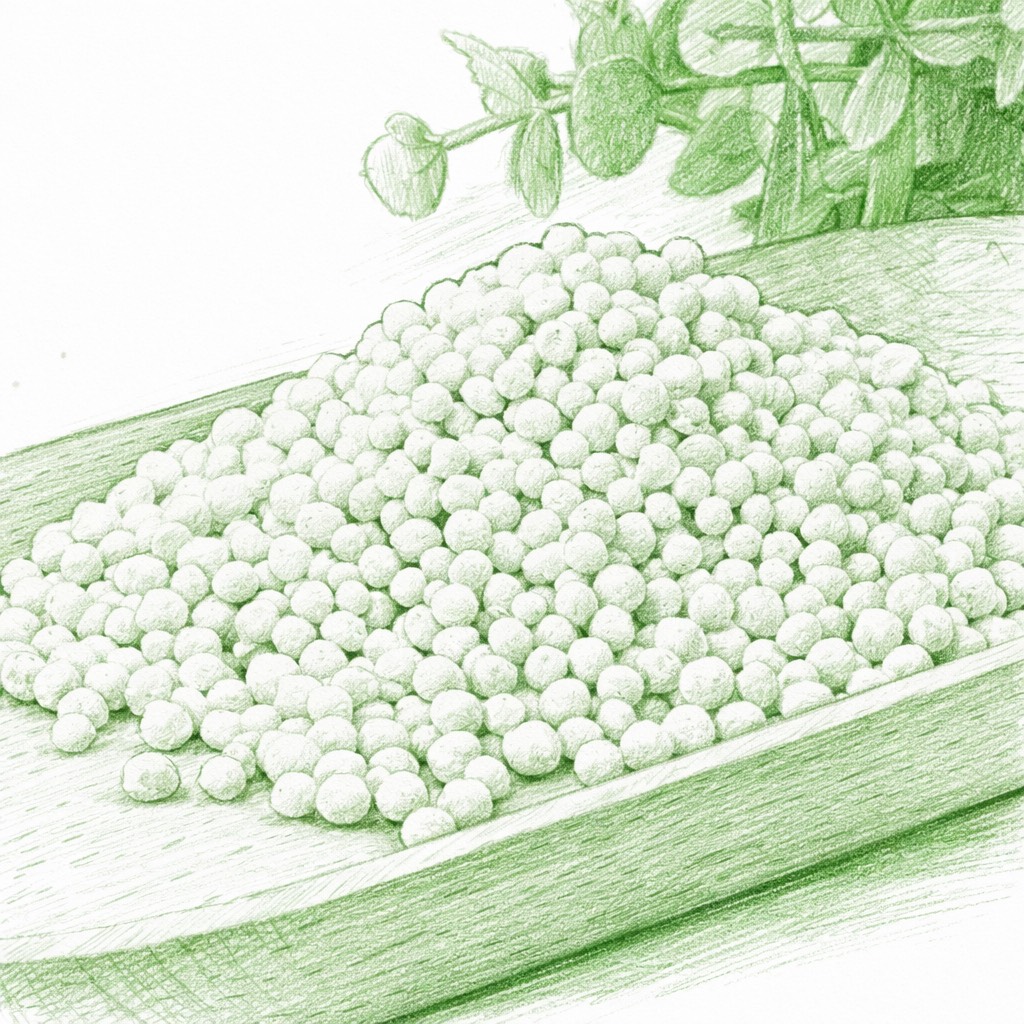
High-analysis nitrogen for modern crop nutrition and export supply
Granular Urea (46-0-0) is a high-analysis nitrogen fertilizer for broad-acre farming, blended programs, and export supply. With a guaranteed 46% total nitrogen, every 1,000 kg of product supplies 460 kg of N. Industrial urea is produced from ammonia and carbon dioxide, then concentrated and finished as a solid fertilizer; official process references note that granulation is used more frequently than prilling for fertilizer-grade urea, and granular urea is generally stronger than prilled product in crushing strength and abrasion resistance.
The agronomic value of urea comes from its nitrogen, but performance depends heavily on management. After application, urease drives hydrolysis of urea to ammonia, which reacts with water to form ammonium; ammonium is then converted in soil to nitrate. Nitrogen is a core component of chlorophyll and proteins, so it directly supports vegetative growth, canopy development, and yield formation. At the same time, hydrolysis near the soil surface can raise local pH around the granule and increase ammonia volatilization risk if the fertilizer is left exposed.
For crop positioning, granular urea fits the core agricultural systems of both Central Asia and Europe. Official sources describe Uzbekistan's output as heavily concentrated in grain, cotton, vegetables and melons, fruit, and potatoes, while EU crop data highlight large cereal and oilseed sectors, with major production of rapeseed, sunflower, and soya. That makes granular urea commercially relevant for cotton-wheat systems, maize, cereals, oilseeds, potatoes, vegetables, orchards, and other crop programs where nitrogen timing is matched to crop demand.
For field use, the strongest practical recommendation is prompt incorporation or timely movement into the soil. University extension guidance states that urea should generally be broadcast and immediately incorporated where possible; when banded, it should be kept at least 2 inches, about 5 cm, away from seed, and it should not be seed-placed in sensitive systems. Extension sources also note that incorporation, irrigation, or enough rainfall soon after application materially reduces volatilization risk, while split nitrogen programs can better match crop uptake and reduce exposure to loss.
Where incorporation is not practical, such as no-till, grassland, or narrow weather windows, NBPT-treated urea is a credible enhanced-efficiency option. Extension guidance explains that urease inhibitors delay urea hydrolysis, and a large review of NBPT reported an average reduction in ammonia loss of about 53% compared with untreated urea. This makes NBPT-stabilized urea a practical commercial option when growers want to protect nitrogen efficiency from surface-loss risk.
From a manufacturing and logistics perspective, urea is synthesized under pressure from ammonia and carbon dioxide, concentrated to molten urea, and then finished by granulation or prilling. Process references also note the use of conditioning agents to reduce dust and caking during storage and transport. For export positioning, it is better to describe quality in terms of verified nitrogen assay, moisture, biuret, particle-size distribution, and physical integrity than to publish generic physical numbers that may later differ from a customer contract or batch Certificate of Analysis. Representative commercial urea specification sheets commonly report exactly these QC parameters.
For distributors and trading companies, the strongest sales proposition is consistency plus documentation. SAM FOS can position granular urea as an export-ready nitrogen fertilizer supported by batch traceability, Certificates of Analysis, disciplined handling guidance, and 4R nutrient stewardship. If the product is marketed through the harmonized EU route, CE-marked EU fertilising products are governed by Regulation (EU) 2019/1009 and can be sold throughout the EU once the applicable quality, safety, efficacy, conformity, and labeling requirements are met.