
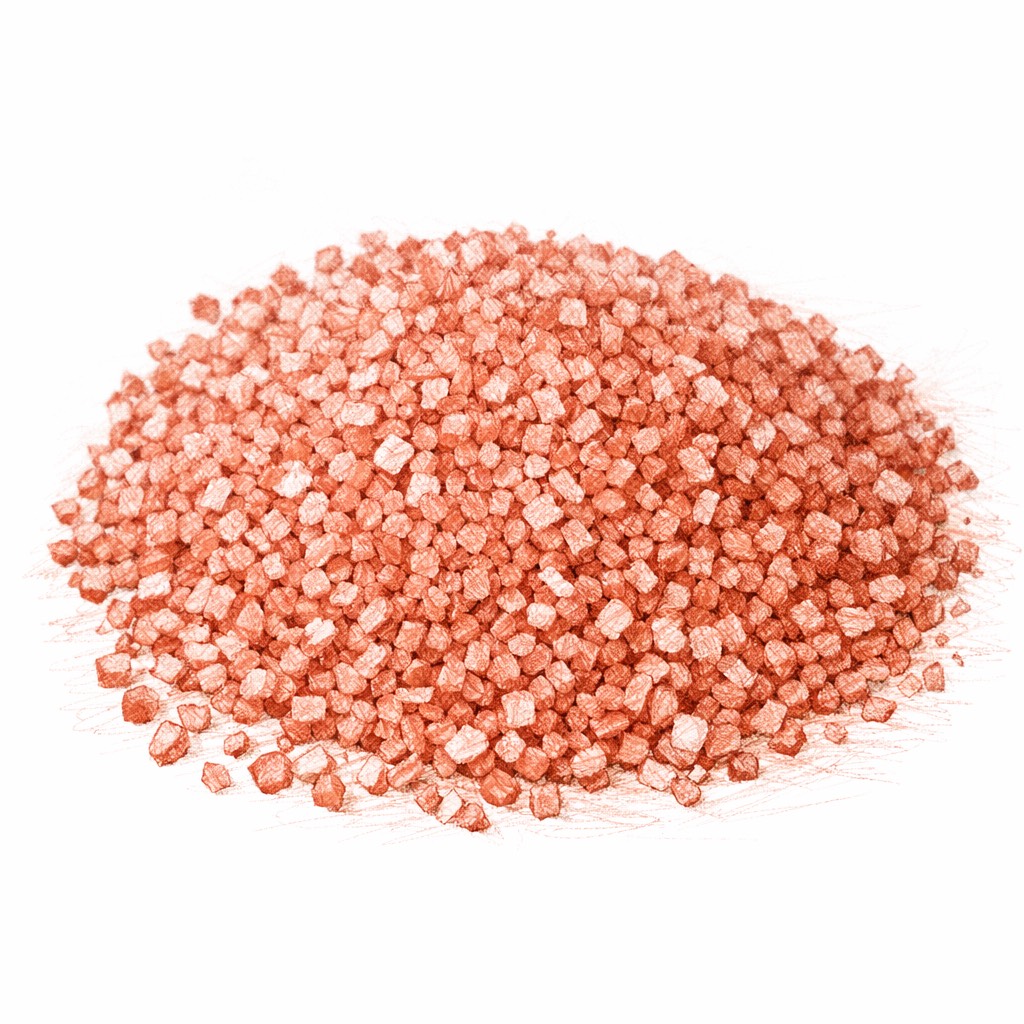
High-analysis potash for field use, blending and export supply
Granular Potassium Chloride (KCl), commonly called Muriate of Potash (MOP), is the most widely applied potassium fertilizer in agriculture because it combines high potassium concentration with competitive cost per unit of nutrient. Commercial MOP is typically marketed on the oxide basis as 0-0-60 to 0-0-62. On the standard fertilizer-label basis, 1,000 kg of 0-0-60 supplies 600 kg K2O, which is equivalent to about 498 kg of elemental potassium using the accepted K2O-to-K conversion factor. Representative standard MOP datasheets commonly show 60% minimum K2O and KCl content in the mid-90s percent range.
Compared with Sulfate of Potash (SOP) and Potassium Nitrate (KNO3), MOP remains the mainstream choice when chloride is acceptable and buyers want the most economical potassium source. SOP is the preferred alternative where chloride additions should be limited in certain soils and crops, and extension sources specifically note its use in chloride-sensitive or quality-focused programs such as potatoes. Potassium nitrate is a chloride-free, fully soluble source more often used in high-value systems that benefit from nitrate nitrogen and water-applied nutrition, including fertigation programs.
In Central Asia, granular MOP fits the main irrigated crop systems that dominate Uzbekistan and the wider region, including cotton, wheat, maize, vegetables, potatoes, orchards, and other horticultural crops. Official and multilateral sources describe Uzbekistan's agricultural output as centered on grain, cotton, vegetables and melons, fruit, and potatoes. In Europe, the strongest fit is across cereals, oilseeds, sugar beet, potatoes, vegetables, and vineyard systems, which aligns with Eurostat reporting on EU crop production and vineyard area.
For field use, granular potassium chloride is commonly positioned as a basal or pre-plant fertilizer, broadcast or placed where soil tests show potassium demand. Because KCl is a soluble salt, direct seed contact is risky. University agronomy sources warn that potash placed too close to seed can cause salt injury, especially in dry conditions or starter-style banding systems. For a product page, the safest wording is to recommend separation from the seed row and application according to soil analysis, crop sensitivity, irrigation conditions, and yield target.
For export markets, the stronger commercial message is not a generic one-size-fits-all granule claim, but controlled product quality. Buyers and intermediaries typically care about verified K2O assay, moisture control, particle-size distribution, caking tendency, crushing strength, dust control, and flowability, because these physical properties directly affect storage stability, mechanical spreading, and bulk handling performance. SAM FOS should therefore position granular potassium chloride as an export-ready potash fertilizer supported by batch Certificates of Analysis, traceability, and buyer-specific packaging and loading terms.
The long-term agronomic value of potassium is also commercially relevant. Adequate potassium supports stomatal regulation, water relations, assimilate transport, and crop performance under drought and heat stress. For stewardship language, the page can safely refer to 4R nutrient management: right source, right rate, right time, and right place. If SAM FOS later chooses the harmonised EU route for an EU fertilising product, CE marking and the associated conformity framework are governed by Regulation (EU) 2019/1009.